
Religious Education
The Principles of our Curriculum:
Research-led: helping children to know more and remember more
Ambitious: every child achieving well
Inclusive: a focus on community and participation
Our Religious Education curriculum allows children to acquire and develop knowledge and understanding of the different beliefs and practices in their communities and around the world. It enhances their spiritual, moral, social and cultural development by asking questions about the world and to reflect on their own beliefs, values and experiences. Our children will have the ability to hold balanced and well-informed conversations about religion and world views and begin to understand the complex world in which they live.
Our curriculum is inclusive and celebrates the diversity and richness of our local community. By promoting understanding and challenging stereotypes, our RE curriculum helps children develop respect, tolerance, and empathy towards others. Our school values of Kindness, Respect, Resilience, and Tolerance are embedded throughout RE planning, ensuring that all pupils are valued, supported, and treated equally.
In Religious Education, our enquiry led approach ensures children explore, evaluate and express different questions centred around Theology, Philosophy and Human and Social Science. Threaded into each enquiry is a range of different religious viewpoints. Through research-led pedagogy, children at Bignold will learn about the main world religions (Christianity, Islam, Judaism, Hinduism, Sikhism and Buddhism) and non-religious worldviews (Humanism).
We use the Norfolk Agreed Syllabus to provide high quality skills and knowledge that are built on year by year and sequenced appropriately to maximise learning for all children. To support our planning and resourcing for all children, including those with SEND and from disadvantaged backgrounds we use The Church of England, Diocese of Norwich website. We have high ambitions for all our children; we scaffold learning when needed so that all children achieve well in Religious Education.
Our RE curriculum is carefully sequenced to ensure that knowledge and understanding build progressively from Nursery through to Year 6, in line with the Norfolk Agreed Syllabus. Children begin by exploring their own experiences, special people, places and celebrations in EYFS, developing an awareness of similarities and differences between themselves and others. As they move through Key Stage 1, pupils are introduced to key beliefs, stories, symbols and practices from a range of religions and worldviews. In Key Stage 2, they deepen their understanding by examining how beliefs influence daily life, worship, values and communities, while also making connections between different faiths and their own experiences. For example, in Year 1 children may learn about special places of worship and why they are important to believers, before building on this in Year 4 by exploring how worship and religious practices express commitment within different faith communities. By Year 6, pupils can engage critically with complex questions about belief, identity, meaning and morality, drawing on the knowledge and understanding they have developed throughout their RE journey. This progressive approach enables children to make meaningful connections across units and develop as reflective, respectful and informed learners.
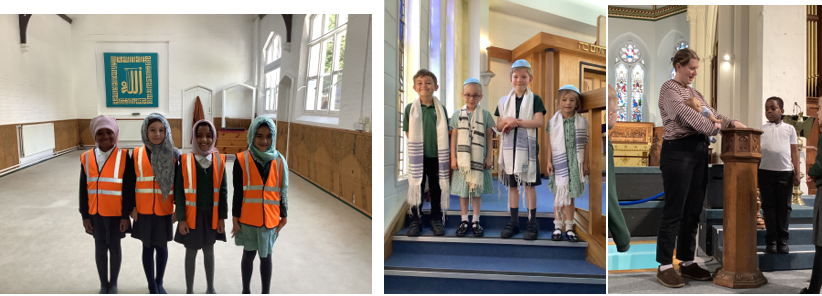
Each year group takes part in a unique and enriching RE visit to a different place of worship, bringing learning to life through first-hand experiences. By the time they leave Bignold, every child will have explored a diverse range of faith communities and sacred spaces, including a church, synagogue, mosque, cathedral, and Buddhist centre. These memorable visits deepen pupils’ understanding of different beliefs and traditions, while fostering curiosity, respect, and appreciation for the diverse world around them.